Forty events, and the software that runs them
40+ events run in two years with teams of five to ten people — and the repetitive half of that job now runs itself, from participant matching to the reminders that go out twice a week without me.
40+ events in two years, with teams of five to ten people each time — and the reason I could keep doing that is that I stopped doing the boring half by hand and built software to do it instead.
The problem: the job is 70% repetition
Running community events looks creative from the outside. From the inside it is a loop: recruit, brief, remind, chase, seat people next to the right strangers, collect feedback, write it up, do it again in three weeks. The WildMeets series, the UNI networking nights, a weekly English board-game meetup, workshops on financial literacy and careers — same loop, new names.
Three things went wrong every single time:
- Reminders. People sign up three weeks out and forget. Somebody had to message them. That somebody was me, on a Sunday.
- Matching. At a networking night, who talks to whom decides whether the evening works. Doing that on paper for 60 people, live, while also running the event, does not work.
- Handover. Every event's knowledge lived in one head, or in a Notion page nobody updated. New volunteers started from zero.
I am the project manager, not the engineering department. Nobody was going to build tools for us. So I built them.
What I built
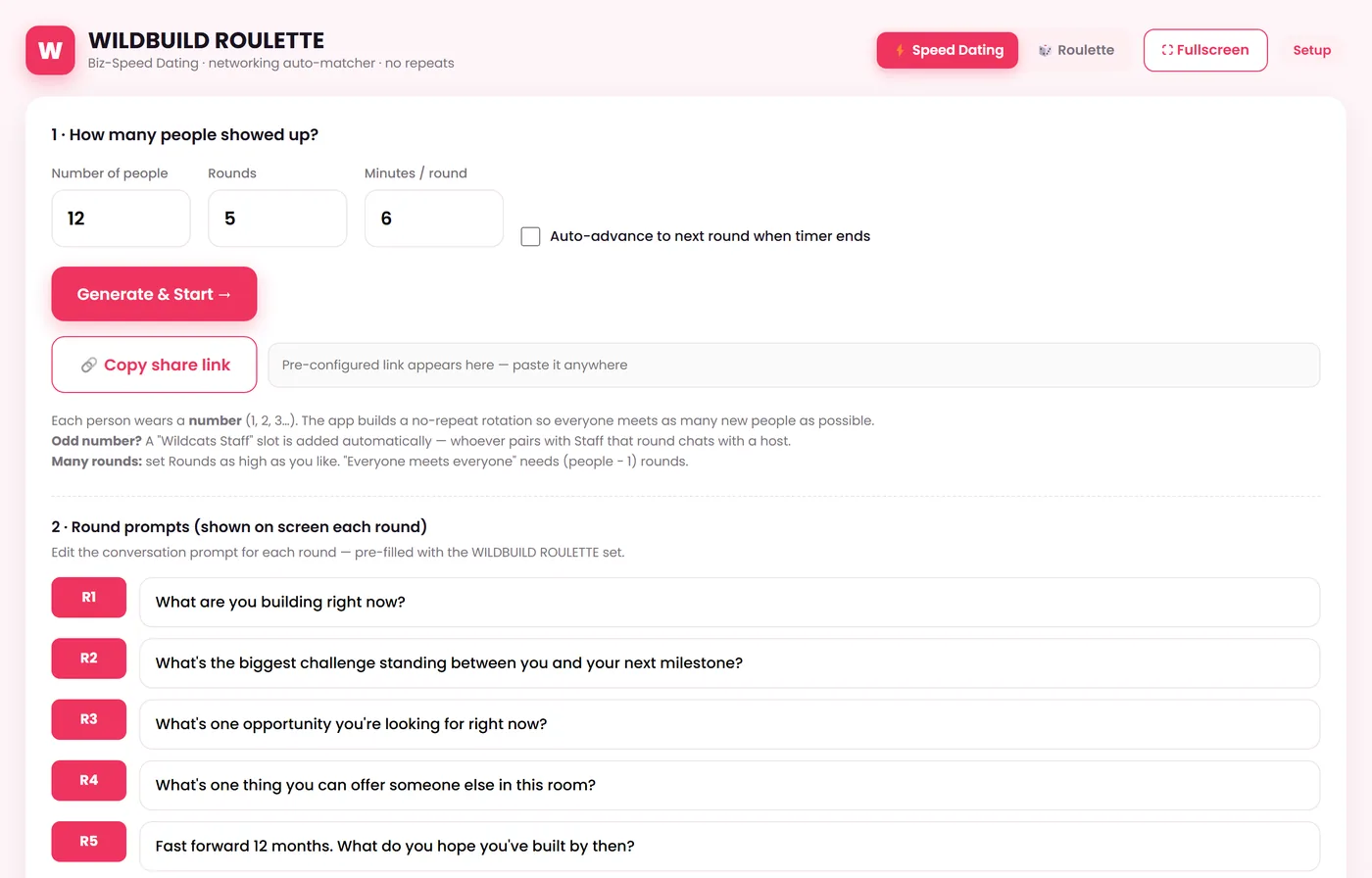
- A live networking matcher — "WildBuild Roulette" — for the WildMeets UNI nights. You type in how many people showed up, how many rounds and how long each one runs; it builds a no-repeat rotation so everybody meets as many new people as possible, puts a conversation prompt on screen each round, and runs the timer. Odd number in the room? It adds a staff slot automatically instead of leaving someone standing. It deploys itself: push a change, a GitHub Action puts it live before the doors open.
- A PM assistant that actually does the admin. It reads and writes our Notion databases, drafts the WhatsApp messages, handles Gmail and Calendar, and reads Google Form responses. Reminders go out automatically every Monday and Thursday at 8am and have done so unattended for months.
- A command centre for the team — one page showing what is running, what is overdue and what needs a human, deployed on push so nobody has to install anything.
- A branded investor deck, 13 slides, rebuilt from a scattered set of documents into one narrative and handed to the founders for their fundraise.
None of this is impressive engineering. All of it removed a recurring Sunday.
Where the AI actually went
The interesting constraint here is that everything is bilingual. Vietnamese and English in the same room, the same email thread, sometimes the same sentence.
- Drafting in two languages, in the right register. Sponsor emails, university invitations and student announcements need three completely different voices. I keep a written voice guide per audience and have AI draft against it — then I edit. It never sends. A human always presses send.
- Turning messy input into structured records. Voice notes and photos of handwritten sign-up sheets become properly-typed Notion rows, with a verification step that shows me what it read before it writes.
- A hard rule I automated: Vietnamese without diacritics is a bug. An automatic check now blocks any Vietnamese text that has lost its accents from ever reaching a public channel, because that mistake shipped once, in a quote, on a public page, and I never wanted it twice.
- Where AI is kept out: anything addressed to a specific human. Every outbound message is a draft until a person approves it. That rule has never been relaxed.
What it changed
| Before | After | |
|---|---|---|
| Event reminders | Manual, on a Sunday | Automatic, Monday and Thursday 8am |
| Networking pairings | Paper and improvisation | A live matcher, rotating on the night |
| Event knowledge | In one person's head | In files, reusable by the next volunteer |
| Sponsor and uni comms | Written from scratch each time | Drafted from a voice guide, edited, sent by a human |
The measurable outcome is not glamorous and it is the point: the same small team keeps delivering events at the same cadence without burning out, and a new volunteer can pick up the running of one without a two-week handover.
What I would do differently
- I automated the reminder before I fixed the sign-up form. Automating a broken input just delivers the wrong thing faster. Fix the data entry point first.
- I built the matcher for the event I had, not the events I would have. The first version assumed even numbers of participants. Real events do not. That got fixed at 6pm on a night with 47 people in the room.
- I under-invested in writing things down for other people. Files are the memory — but only if somebody other than me can read them. That is the whole reason this page exists in this format.
The transferable part
Every organisation that runs recurring things — events, onboarding cohorts, client check-ins, monthly reporting — is paying a person to be a reminder system. That is the cheapest, most obvious AI win available, and almost nobody has taken it. The trick is not the automation. It is being strict about the line: the machine can prepare anything and send nothing.
- Organisation
- Wildcats — an international community and events organisation in Đà Nẵng
- Role
- Project Manager, September 2024 to present
- Scope
- Event delivery, team coordination, sponsor and university relations, internal tooling
- Audience
- Bilingual — Vietnamese and English, in the same room
- Built
- Speed-dating matcher · a PM assistant that handles Notion, WhatsApp, Gmail, Calendar and Forms · a command centre for the team
- Live at
- wildcats-speed-dating.pages.dev
Got something like this? Tell me what's broken.